
Contents
- 1 When Caletti Builds a Time Machine: The Bay To Breakers Single-Speed That Honors a Grandmother’s Legacy
- 1.1 The Commission: More Than Just Another Build
- 1.2 The Grandmother’s Story: 1985 Bay To Breakers
- 1.3 John Caletti: The Builder’s Approach
- 1.4 Design Translation: From Cotton to Steel
- 1.5 The Frame Construction
- 1.6 Component Selection and Color Matching
- 1.7 Modern Performance, Retro Aesthetic
- 1.8 The Deeper Meaning: Legacy and Memory
- 1.9 Conclusion: Going Back to Move Forward
- 1.10 Essential Gear for Single-Speed Mountain Biking
When Caletti Builds a Time Machine: The Bay To Breakers Single-Speed That Honors a Grandmother’s Legacy
 SPECIAL THANKS TO THE SPOKEN.COM AND PETER THOMSEN FOR THE IMAGE CONTAINED IN THIS ARTICLE!
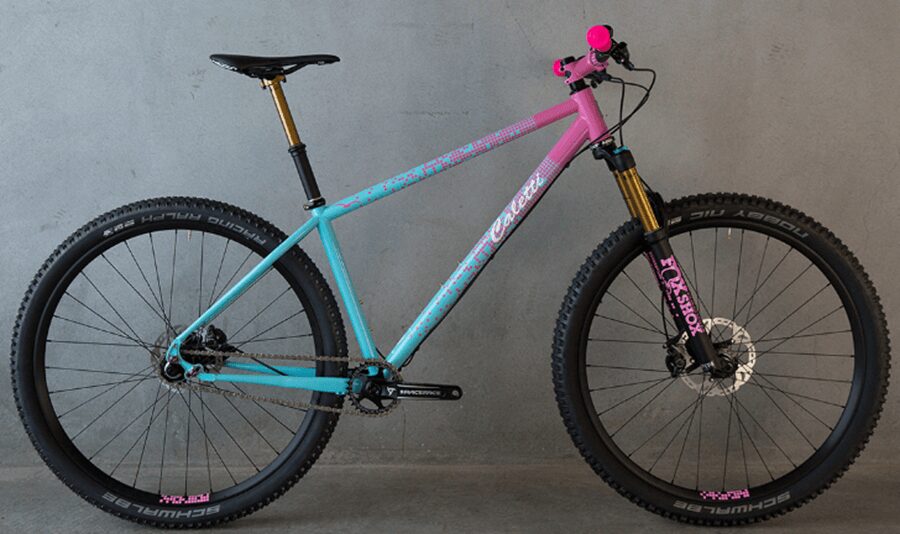
In October 2017, Santa Cruz frame builder John Caletti completed a mountain bike that defies conventional categorization. This single-speed MTB wears the design of a 1985 Bay To Breakers race t-shirt, transforming a grandmother’s racing memory into functional trail equipment. To preserve that one-of-a-kind finish on every ride, he applied a clear protective frame wrap– a simple, transparent film that shields the paint from chips while keeping the story visible. The result is a modern mountain bike that serves as both high-performance machine and rolling memorial—proving that sometimes going backward aesthetically means moving forward emotionally.
The Commission: More Than Just Another Build
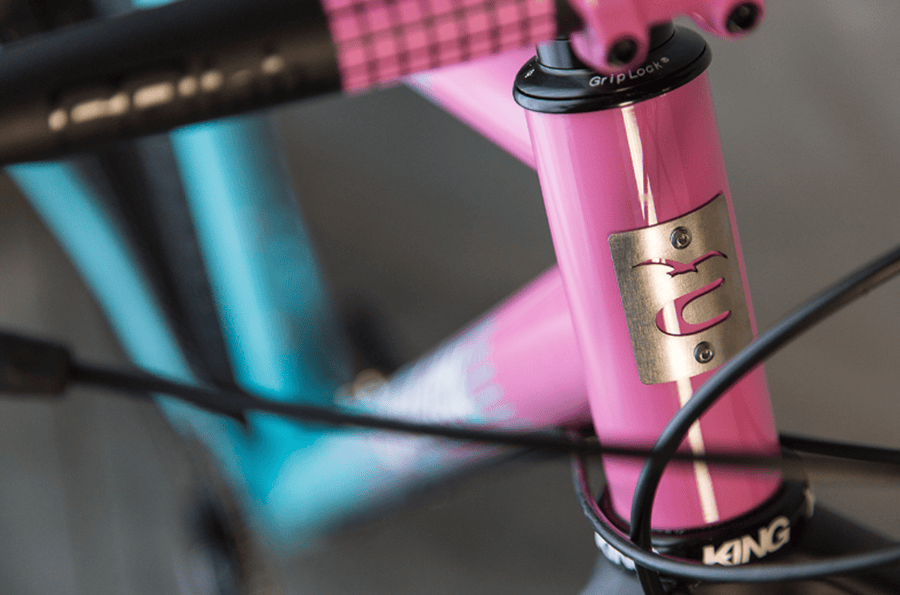
Covey Potter approached John Caletti with an unusual request in 2017. Both Santa Cruz locals, they shared an understanding of the area’s cycling culture and the importance of personal connection in custom builds. Potter wanted a single-speed mountain bike, but not just any single-speed. He carried with him a vibrant t-shirt from the 1985 Bay To Breakers race, asking Caletti to translate its design onto the frame. To complete the custom look, he added color-matched MTB grips for a pop of style and extra control on the trail.
The timing proved significant. Potter’s grandmother had passed away earlier in 2017, leaving him the commemorative shirt from her race participation. Rather than preserve the shirt in storage, Potter chose to transform it into something functional—a bike he could ride regularly, keeping her memory alive through use rather than static preservation.
This Caletti build was actually completed in October 2017, but remained undocumented in The Spoken’s storage vaults until recently. The delay in coverage doesn’t diminish the build’s impact. If anything, the passage of time has proven the lasting power of Caletti’s interpretation and the enduring appeal of deeply personal custom work.
The project required more than technical skill. Caletti needed to balance faithful reproduction of the shirt’s design with the practical requirements of a functional mountain bike. The builder understood he wasn’t just constructing a frame—he was creating a memorial that would face trail abuse while maintaining its emotional significance.
The Grandmother’s Story: 1985 Bay To Breakers
The Bay To Breakers race represents more than just another San Francisco running event. Since 1912, this 12K race has drawn participants ranging from serious athletes to costumed revelers, creating a uniquely San Francisco blend of competition and celebration. By 1985, the race had evolved into a cultural phenomenon, attracting over 100,000 participants annually. Endurance events like this—and long days on the MTB—are easier with alightweight hydration pack that keeps water close without slowing you down.
Potter’s grandmother joined these masses in 1985, though her participation came “not without incident” according to family history. The specific challenges she faced remain private, but completing the race earned her the commemorative t-shirt that would later inspire this build. That shirt, with its distinctly 1980s aesthetic, featured the bold graphics and vibrant colors characteristic of the era’s design language.
The 1985 race occurred during peak MTV influence, when neon colors and geometric patterns dominated visual culture. The shirt’s design reflected this aesthetic—bold, unapologetic, and impossible to ignore. For Potter’s grandmother, the shirt represented personal achievement. For Potter, it became a tangible connection to her memory and determination.
Her passing in 2017 left Potter with both grief and inspiration. The shirt could have remained folded in a drawer, occasionally viewed but rarely engaged with. Instead, Potter recognized an opportunity to transform static memory into active celebration. By commissioning Caletti to reproduce the design on a mountain bike, he ensured daily interaction with his grandmother’s legacy.
John Caletti: The Builder’s Approach
John Caletti operates from Santa Cruz, California, where mountain biking culture runs deep. His reputation extends beyond technical proficiency to include an understanding of bikes as personal expression. This combination made him the ideal builder for Potter’s memorial project.
Caletti’s workshop has produced numerous custom frames, but this project demanded different skills. Beyond tube selection and geometry calculations, he needed to serve as interpreter and curator, translating textile design to painted steel. The builder recognized that accuracy mattered less than capturing the shirt’s spirit and the grandmother’s story. To honor that spirit long after it hit the trails, he finished the bike with a gentle detailing routine—using an eco-friendly cleaner like the Muc Off Ultimate Bike Wash to maintain the paint’s glow without risking swirl marks or scratches.
The technical challenge involved multiple considerations. Paint must withstand trail abuse while maintaining vibrancy. The design needed to work within the constraints of frame geometry. Most importantly, the finished bike had to function as intended—a rideable mountain bike, not a display piece.
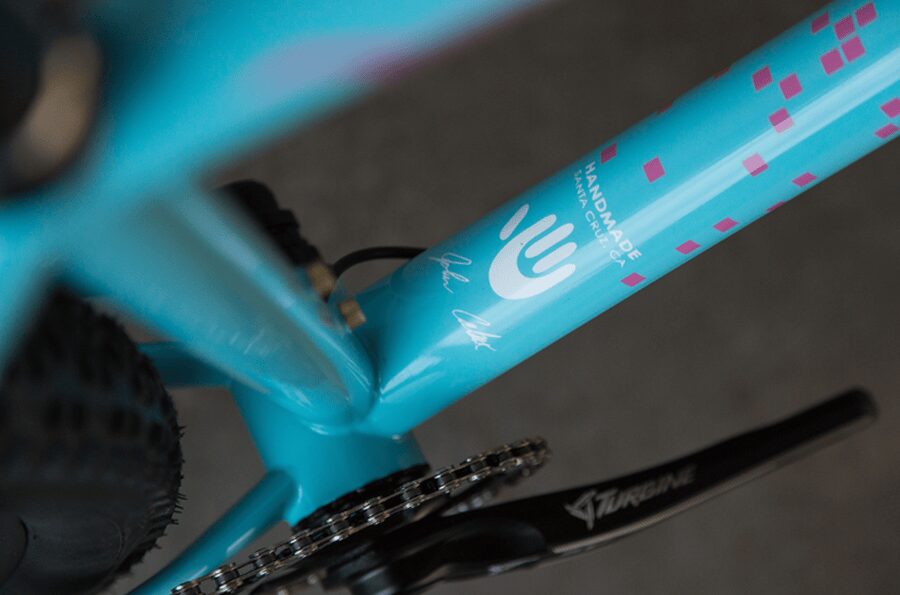
Caletti partnered with painter Peter Thomsen for the project. Thomsen’s expertise in custom bicycle painting proved essential for executing the complex design. Together, they studied the original shirt, identifying key elements that would translate to the frame while planning how to adapt others for the three-dimensional canvas of steel tubes.
Design Translation: From Cotton to Steel
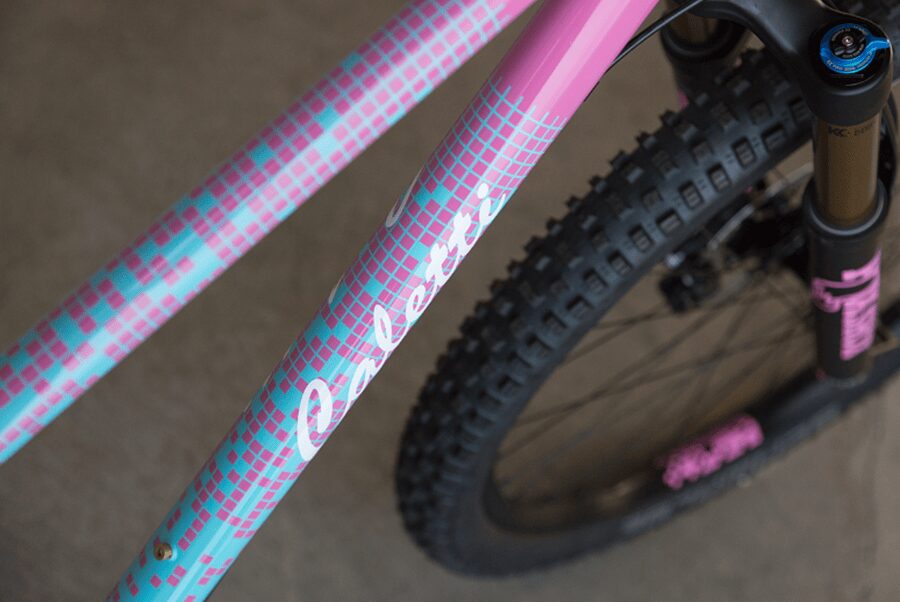
The original t-shirt embodied 1985 design sensibilities—what might be described as “more MTV than MTB” in aesthetic terms. Geometric patterns, gradient effects, and bold color transitions characterized the era’s visual language. These elements, designed for flat fabric, required creative interpretation for cylindrical tubes and complex frame joints.
Caletti and Thomsen identified the shirt’s essential elements: the color palette, primary graphics, and overall energy. They recognized that literal reproduction would fail—a bike frame presents different proportions and viewing angles than a t-shirt. Instead, they focused on capturing the design’s spirit while adapting it to the frame’s geometry.
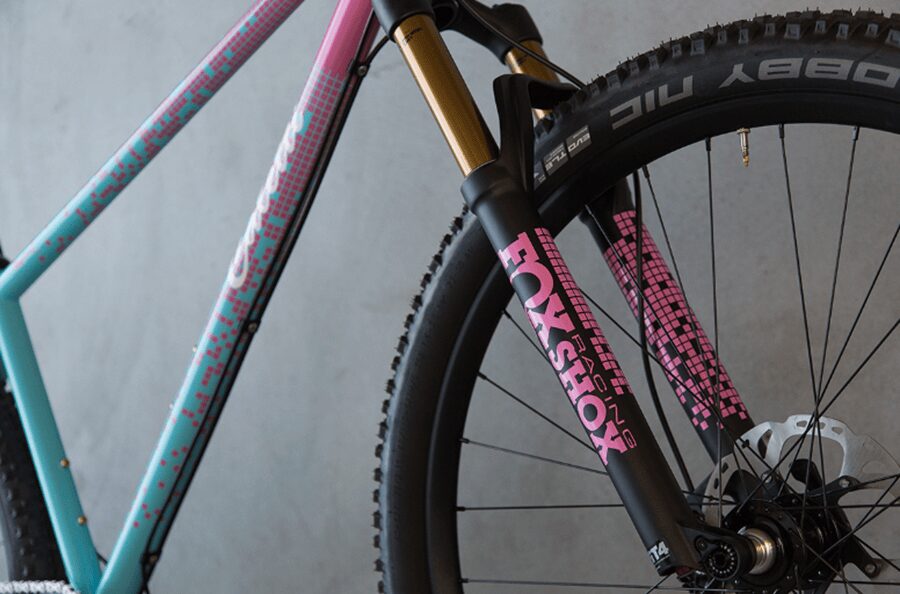
The paint scheme employs period-appropriate colors, including neon accents that immediately signal 1980s origin. These bright elements contrast with more subdued base colors, creating visual interest without overwhelming the frame’s lines. The painters used modern materials and techniques, ensuring durability that matches the bold appearance. For builders interested in similar projects,high-quality masking tape and automotive-grade clear coat prove essential for achieving clean lines and long-lasting finishes.
The MTV comparison proves apt beyond mere chronology. Music Television’s early years featured bold graphics and experimental visuals that defined a generation’s aesthetic expectations. This Caletti build captures that same willingness to prioritize visual impact, though with far more personal meaning than any music video.
The successful translation required selective interpretation. Some shirt elements scaled directly to the frame, while others needed modification or elimination. The result maintains the shirt’s essential character while functioning as coherent bicycle design.
The Frame Construction
Building a single-speed mountain bike requires specific design considerations that differ from geared bikes. Caletti addressed these requirements while maintaining compatibility with modern components and riding expectations. The frame geometry reflects contemporary trail bike standards rather than 1985 mountain bike dimensions, ensuring the bike rides as well as it looks.
The steel frame construction allows for precise tube shaping and junction finishing that aluminum or carbon can’t match. Caletti selected tubing appropriate for Potter’s weight and riding style, balancing strength with responsive handling. Single-speed frames benefit from additional reinforcement at high-stress points, particularly the bottom bracket area where all pedaling forces concentrate without the mechanical advantage of multiple gears.
Chain tension management proves critical for single-speed mountain bikes. Unlike track bikes with horizontal dropouts, modern mountain bikes require alternative solutions. Caletti incorporated features allowing proper chain tension while maintaining modern wheel standards and brake compatibility. Riders building similar single-speed conversions should invest in a quality chain tensioner or consider eccentric bottom brackets for reliable performance.
The frame’s geometry accommodates the Fox 34 fork’s 130mm travel while maintaining appropriate handling characteristics. This requires careful calculation of head tube angle, bottom bracket height, and chainstay length. The result feels stable at speed while remaining agile enough for technical trail sections.
Cable routing becomes simplified on single-speed builds, with only brake lines requiring management. Caletti’s clean routing solution maintains the frame’s visual lines while protecting cables from trail debris.
Component Selection and Color Matching
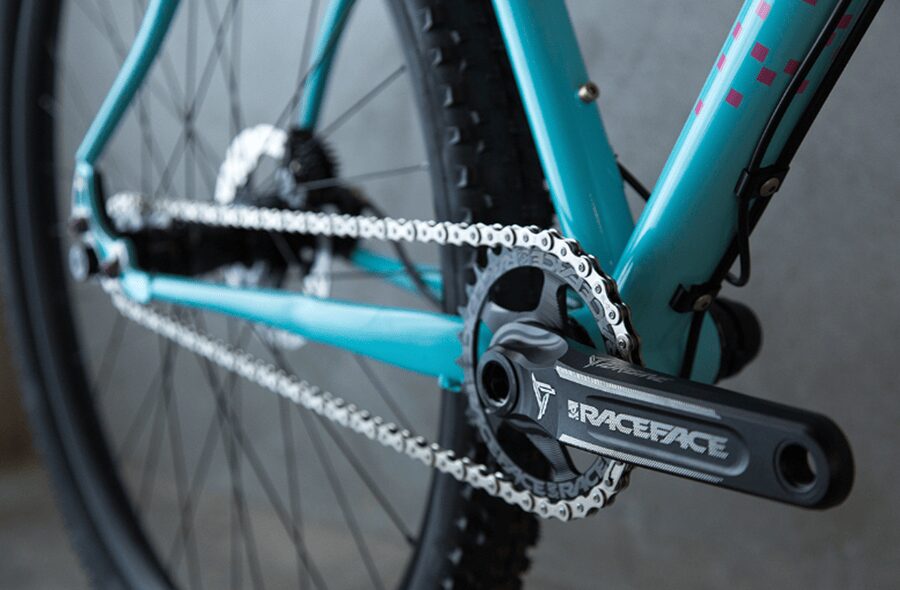
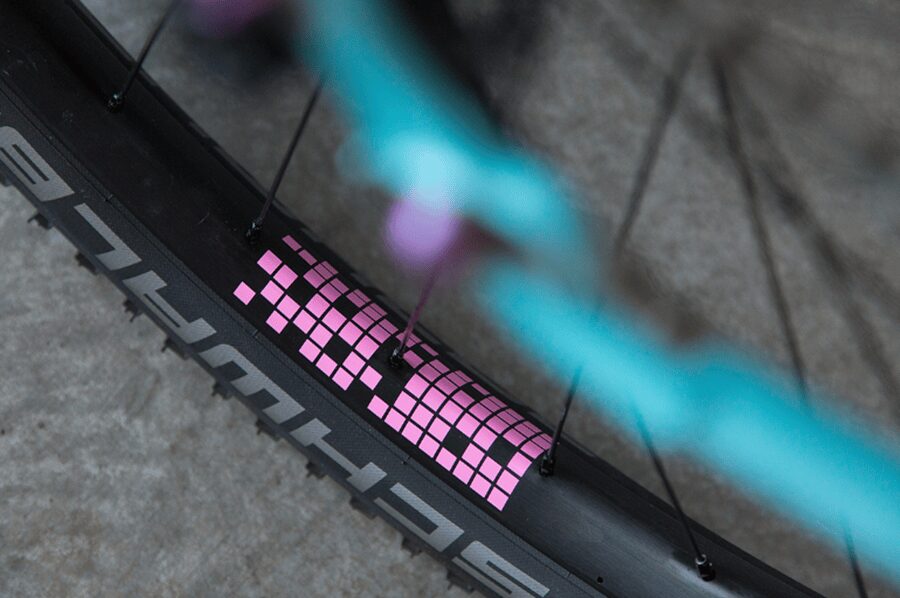
The component specification elevates this build beyond typical custom frames. Rather than simply bolting on standard parts, Caletti coordinated a complete color-matched system that extends the paint scheme throughout the bike. This comprehensive approach required painting components typically left in factory finishes.
The Fox 34 fork represents a significant investment in both performance and aesthetics. This 130mm travel fork provides modern suspension performance with adjustable compression and rebound damping. Painting the fork to match the frame required careful preparation and specialized techniques to ensure paint adhesion to the magnesium lowers. Mountain bikers seeking similar performance can find the Fox 34 Performance fork though custom painting voids warranties.
Easton provided the stem, likely from their Haven or EA50 series, which received matching paint treatment. Painting aluminum components requires different preparation than steel, including proper etching primer for paint adhesion. The color-matched stem creates visual continuity between frame and cockpit.
Chris King’s wheelset brings both performance and customization possibilities. King offers extensive anodizing options through their color program, though this build went further with custom paint matching. The wheels likely feature King’s ISO hubs, renowned for their durability and precise engagement. The Chris King tool kit becomes essential for proper maintenance of these precision components.
The complete color matching extends to small details often overlooked. Headset spacers, seatpost collar, and even bolt heads received consideration in the overall aesthetic plan. This attention to detail separates exceptional custom builds from merely good ones.
Modern Performance, Retro Aesthetic
The phrase “up-to-date geometry and components” understates the technical achievement. This Caletti successfully bridges three decades of mountain bike evolution, combining 1985 aesthetics with 2017 performance standards. The geometry reflects modern trail bike thinking: slacker head angles, longer top tubes, and shorter stems compared to 1980s standards.
A 1985 mountain bike typically featured a 71-degree head angle, 22-inch top tube, and 17-inch chain stays. Modern trail geometry employs 66-68 degree head angles, virtual top tubes exceeding 23 inches, and chain stays around 16.5 inches. These changes dramatically improve stability and handling, particularly on steep terrain that would challenge vintage geometry.
Single-speed configuration offers specific advantages for modern trail riding. Mechanical simplicity means less maintenance and fewer potential failures. The direct power transfer creates an engaging riding experience, forcing riders to choose optimal lines and maintain momentum. Weight savings, while secondary to the memorial aspect, make the bike more responsive. For riders interested in single-speed conversion, a quality single-speed kit provides necessary components.
The Fox 34 fork’s adjustability allows tuning for different trail conditions, compensating for the gear limitation. Modern tire clearance accommodates up to 2.4-inch tires, providing traction and comfort impossible with 1985’s narrow rubber. The bike can handle technical terrain that would damage vintage bikes, despite its retro appearance.
This juxtaposition—modern capability wrapped in retro aesthetics—creates cognitive dissonance at trailheads. Observers see 1985 but the bike performs like 2017, challenging assumptions about the relationship between appearance and function.
The Deeper Meaning: Legacy and Memory
This Caletti transcends typical custom bike territory by functioning as active memorial. Every ride connects Potter with his grandmother’s memory, transforming grief into celebration. The bike’s visibility ensures regular conversations about her story, keeping her memory alive within the community.
Traditional memorials—headstones, plaques, photographs—offer static remembrance. This bike provides dynamic interaction, requiring maintenance, generating experiences, and creating new stories while honoring the original. With a compact multi-tool like the Mossy Oak Multitool, every ride becomes an opportunity to perform quick repairs, ensuring the bike’s legacy continues through every adventure. The physical engagement of riding creates stronger memory connections than passive viewing.
The bike initiates conversations at every trailhead and bike shop. The bold design demands attention, leading to questions that allow Potter to share his grandmother’s story. This social aspect extends her influence beyond family, creating new connections through shared appreciation of the memorial’s creativity.
Functional memorials like this Caletti offer therapeutic value. The physical activity of riding, combined with the emotional connection to the bike’s meaning, provides healthy grief processing. The bike transforms loss into action, sadness into celebration, absence into presence.
Conclusion: Going Back to Move Forward
Caletti’s execution of Potter’s vision demonstrates how custom frame building transcends mere manufacturing. By faithfully interpreting a 1985 t-shirt design onto a 2017 mountain bike, Caletti created something entirely new—a functional memorial that celebrates life through use rather than static display.
The build succeeds on multiple levels. Technically, it’s a capable modern mountain bike with quality components and thoughtful geometry. Aesthetically, it captures 1980s design energy while maintaining visual coherence. Emotionally, it provides ongoing connection to family history and personal loss. To enhance both comfort and style, consider upgrading to a durable, sleek MTB saddle that keeps every ride connected and pain-free.
This Caletti Bay To Breakers bike proves that sometimes regression in appearance enables progression in meaning. The retro paint scheme doesn’t indicate backward thinking but rather deep consideration of how objects carry memory and create connection. In an era of mass production and disposable goods, this deeply personal custom build reminds us why craftsmanship and storytelling matter.
For Potter, every ride becomes an act of remembrance. For Caletti, the build represents the highest purpose of custom frame building—creating objects that matter beyond their mechanical function. For the rest of us, it’s a reminder that the best bikes aren’t just about performance metrics but about the stories they carry and connections they create.
Essential Gear for Single-Speed Mountain Biking
- Park Tool Single-Speed Splined Tool – Essential for single-speed maintenance
- White Industries ENO Freewheel – Premium single-speed freewheel option
- KMC S1 Single-Speed Chain – Durable chain for single-speed use
- Surly Singleator Tensioner – Chain tension solution
- Park Tool Chain Checker – Monitor chain wear
- Finish Line Ceramic Wet Lube – Premium chain lubrication
- Feedback Sports Bike Stand – Professional work stand for maintenance
- Custom Frame Protection Tape – Protect custom paint from cable rub
Disclaimer: We are an Amazon affiliate and earn from qualified Amazon purchases with no cost to you. This includes ANY item you purchase through our links.